Autor: wordpressadmin

  • Ready for EV-Use

    Ready for EV-Use

    As the number of electric vehicles (EVs) on our roads continues to rise, it has become increasingly important that vehicle restraint systems (VRS) provide the same level of protection for EVs as they do for conventional vehicles. REBLOC has now taken its VRS a step further, demonstrating the suitability of precast concrete barriers for any kind of vehicle hitting the road.

    Successful Full-Scale Crash Test with a Tesla Model 3

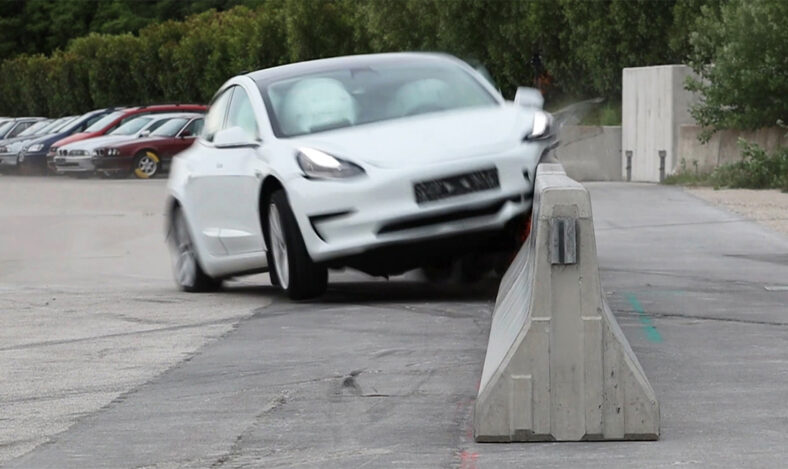
    REBLOC recently carried out a full-scale crash test with an anchored REBLOC precast concrete barrier and an EV. The test vehicle was a Tesla Model 3 with a mass of approximately 1,900 kg.

    The crash test, with an impact speed of 110 km/h and 20° impact angle, replicated the criteria of the TB32 test in accordance with the requirements defined in EN 1317-2. However, while the EN 1317-2 standard specifies a vehicle mass of 1,500 kg for the TB32, the Tesla used in this test was approximately 400 kg heavier, realising an impact energy of 103.8 kJ, which is 28 % higher than the TB32 test.

    The results were highly impressive. Vehicle behaviour during and after the impact was excellent, demonstrating controlled deceleration and effective redirection. The barrier performed as intended, with no damage to the vehicle restraint system and without any barrier components becoming loose during or after the collision.

    So, the barrier remained intact and capable of operating as it was designed to following the impact and the vehicle behaviour was exemplary. But what about the EV’s battery? This question was one of the key objectives of the conducted crash test. To evaluate the state of the battery after such a severe impact was a leap into the unknown. The battery remained intact throughout the crash test and showed no signs of damage that could lead to thermal runaway or fire.

    As a precautionary measure, the vehicle was immediately recovered after the impact and placed in a specially designed safety container equipped with smoke detectors and a flooding system. The vehicle remained under observation for 48 hours. During this period and afterwards, no signs of battery malfunction or ignition were detected.

    Funny side note from the test: Tesla’s emergency assistance system remained operational after the collision and automatically alerted the emergency services. To the surprise of the crash test team, the police arrived at the test site. However, this demonstrates that critical vehicle safety functions remain active even after the impact.

    Addressing an Urgent Topic on our Roads

    Currently, EVs are not specifically addressed within existing road safety standards. As a result, the availability of crash test data evaluating interaction between EVs and vehicle restraint systems is limited.

    A few crash tests conducted in North America involving electric vehicles and steel guardrail systems highlighted potential challenges for protection. Due to the battery being packed in the vehicle’s floor pan, an EV’s lower centre of gravity can cause the guardrail to be lifted during impact, allowing the vehicle to under-ride the system, resulting in unsatisfactory performance.

    The REBLOC test demonstrates that precast concrete barriers offer a robust and reliable solution for modern vehicles, including EVs. The successful performance of the barrier, combined with the positive vehicle behaviour, provides strong evidence that precast concrete barriers are well suited to the evolving demands of road safety.

    Precast Concrete Barriers for EV-use

    With the number of EVs rapidly increasing worldwide, it is essential that vehicle restraint systems are evaluated under realistic conditions that reflect today’s vehicle fleet. This dedicated crash test represents an important milestone in understanding the interaction between electric vehicles and vehicle restraint systems.

    The successful crash test results confirm that precast concrete barriers are ready for the challenges posed by EVs and continue to provide a high level of protection for all users.

  • Ready for EV-Use

    Ready for EV-Use

    As the number of electric vehicles (EVs) on our roads continues to rise, it has become increasingly important that vehicle restraint systems (VRS) provide the same level of protection for EVs as they do for conventional vehicles. REBLOC has now taken its VRS a step further, demonstrating the suitability of precast concrete barriers for any kind of vehicle hitting the road.

    Successful Full-Scale Crash Test with a Tesla Model 3

    REBLOC recently carried out a full-scale crash test with an anchored REBLOC precast concrete barrier and an EV. The test vehicle was a Tesla Model 3 with a mass of approximately 1,900 kg.

    The crash test, with an impact speed of 110 km/h and 20° impact angle, replicated the criteria of the TB32 test in accordance with the requirements defined in EN 1317-2. However, while the EN 1317-2 standard specifies a vehicle mass of 1,500 kg for the TB32, the Tesla used in this test was approximately 400 kg heavier, realising an impact energy of 103.8 kJ, which is 28 % higher than the TB32 test.

    The results were highly impressive. Vehicle behaviour during and after the impact was excellent, demonstrating controlled deceleration and effective redirection. The barrier performed as intended, with no damage to the vehicle restraint system and without any barrier components becoming loose during or after the collision.

    So, the barrier remained intact and capable of operating as it was designed to following the impact and the vehicle behaviour was exemplary. But what about the EV’s battery? This question was one of the key objectives of the conducted crash test. To evaluate the state of the battery after such a severe impact was a leap into the unknown. The battery remained intact throughout the crash test and showed no signs of damage that could lead to thermal runaway or fire.

    As a precautionary measure, the vehicle was immediately recovered after the impact and placed in a specially designed safety container equipped with smoke detectors and a flooding system. The vehicle remained under observation for 48 hours. During this period and afterwards, no signs of battery malfunction or ignition were detected.

    Funny side note from the test: Tesla’s emergency assistance system remained operational after the collision and automatically alerted the emergency services. To the surprise of the crash test team, the police arrived at the test site. However, this demonstrates that critical vehicle safety functions remain active even after the impact.

    Addressing an Urgent Topic on our Roads

    Currently, EVs are not specifically addressed within existing road safety standards. As a result, the availability of crash test data evaluating interaction between EVs and vehicle restraint systems is limited.

    A few crash tests conducted in North America involving electric vehicles and steel guardrail systems highlighted potential challenges for protection. Due to the battery being packed in the vehicle’s floor pan, an EV’s lower centre of gravity can cause the guardrail to be lifted during impact, allowing the vehicle to under-ride the system, resulting in unsatisfactory performance.

    The REBLOC test demonstrates that precast concrete barriers offer a robust and reliable solution for modern vehicles, including EVs. The successful performance of the barrier, combined with the positive vehicle behaviour, provides strong evidence that precast concrete barriers are well suited to the evolving demands of road safety.

    Precast Concrete Barriers for EV-use

    With the number of EVs rapidly increasing worldwide, it is essential that vehicle restraint systems are evaluated under realistic conditions that reflect today’s vehicle fleet. This dedicated crash test represents an important milestone in understanding the interaction between electric vehicles and vehicle restraint systems.

    The successful crash test results confirm that precast concrete barriers are ready for the challenges posed by EVs and continue to provide a high level of protection for all users.

  • Ready for EV-Use

    Ready for EV-Use

    As the number of electric vehicles (EVs) on our roads continues to rise, it has become increasingly important that vehicle restraint systems (VRS) provide the same level of protection for EVs as they do for conventional vehicles. REBLOC has now taken its VRS a step further, demonstrating the suitability of precast concrete barriers for any kind of vehicle hitting the road.

    Successful Full-Scale Crash Test with a Tesla Model 3

    REBLOC recently carried out a full-scale crash test with an anchored REBLOC precast concrete barrier and an EV. The test vehicle was a Tesla Model 3 with a mass of approximately 1,900 kg.

    The crash test, with an impact speed of 110 km/h and 20° impact angle, replicated the criteria of the TB32 test in accordance with the requirements defined in EN 1317-2. However, while the EN 1317-2 standard specifies a vehicle mass of 1,500 kg for the TB32, the Tesla used in this test was approximately 400 kg heavier, realising an impact energy of 103.8 kJ, which is 28 % higher than the TB32 test.

    The results were highly impressive. Vehicle behaviour during and after the impact was excellent, demonstrating controlled deceleration and effective redirection. The barrier performed as intended, with no damage to the vehicle restraint system and without any barrier components becoming loose during or after the collision.

    So, the barrier remained intact and capable of operating as it was designed to following the impact and the vehicle behaviour was exemplary. But what about the EV’s battery? This question was one of the key objectives of the conducted crash test. To evaluate the state of the battery after such a severe impact was a leap into the unknown. The battery remained intact throughout the crash test and showed no signs of damage that could lead to thermal runaway or fire.

    As a precautionary measure, the vehicle was immediately recovered after the impact and placed in a specially designed safety container equipped with smoke detectors and a flooding system. The vehicle remained under observation for 48 hours. During this period and afterwards, no signs of battery malfunction or ignition were detected.

    Funny side note from the test: Tesla’s emergency assistance system remained operational after the collision and automatically alerted the emergency services. To the surprise of the crash test team, the police arrived at the test site. However, this demonstrates that critical vehicle safety functions remain active even after the impact.

    Addressing an Urgent Topic on our Roads

    Currently, EVs are not specifically addressed within existing road safety standards. As a result, the availability of crash test data evaluating interaction between EVs and vehicle restraint systems is limited.

    A few crash tests conducted in North America involving electric vehicles and steel guardrail systems highlighted potential challenges for protection. Due to the battery being packed in the vehicle’s floor pan, an EV’s lower centre of gravity can cause the guardrail to be lifted during impact, allowing the vehicle to under-ride the system, resulting in unsatisfactory performance.

    The REBLOC test demonstrates that precast concrete barriers offer a robust and reliable solution for modern vehicles, including EVs. The successful performance of the barrier, combined with the positive vehicle behaviour, provides strong evidence that precast concrete barriers are well suited to the evolving demands of road safety.

    Precast Concrete Barriers for EV-use

    With the number of EVs rapidly increasing worldwide, it is essential that vehicle restraint systems are evaluated under realistic conditions that reflect today’s vehicle fleet. This dedicated crash test represents an important milestone in understanding the interaction between electric vehicles and vehicle restraint systems.

    The successful crash test results confirm that precast concrete barriers are ready for the challenges posed by EVs and continue to provide a high level of protection for all users.

  • Ready for EV-Use

    Ready for EV-Use

    As the number of electric vehicles (EVs) on our roads continues to rise, it has become increasingly important that vehicle restraint systems (VRS) provide the same level of protection for EVs as they do for conventional vehicles. REBLOC has now taken its VRS a step further, demonstrating the suitability of precast concrete barriers for any kind of vehicle hitting the road.

    Successful Full-Scale Crash Test with a Tesla Model 3

    REBLOC recently carried out a full-scale crash test with an anchored REBLOC precast concrete barrier and an EV. The test vehicle was a Tesla Model 3 with a mass of approximately 1,900 kg.

    The crash test, with an impact speed of 110 km/h and 20° impact angle, replicated the criteria of the TB32 test in accordance with the requirements defined in EN 1317-2. However, while the EN 1317-2 standard specifies a vehicle mass of 1,500 kg for the TB32, the Tesla used in this test was approximately 400 kg heavier, realising an impact energy of 103.8 kJ, which is 28 % higher than the TB32 test.

    The results were highly impressive. Vehicle behaviour during and after the impact was excellent, demonstrating controlled deceleration and effective redirection. The barrier performed as intended, with no damage to the vehicle restraint system and without any barrier components becoming loose during or after the collision.

    So, the barrier remained intact and capable of operating as it was designed to following the impact and the vehicle behaviour was exemplary. But what about the EV’s battery? This question was one of the key objectives of the conducted crash test. To evaluate the state of the battery after such a severe impact was a leap into the unknown. The battery remained intact throughout the crash test and showed no signs of damage that could lead to thermal runaway or fire.

    As a precautionary measure, the vehicle was immediately recovered after the impact and placed in a specially designed safety container equipped with smoke detectors and a flooding system. The vehicle remained under observation for 48 hours. During this period and afterwards, no signs of battery malfunction or ignition were detected.

    Funny side note from the test: Tesla’s emergency assistance system remained operational after the collision and automatically alerted the emergency services. To the surprise of the crash test team, the police arrived at the test site. However, this demonstrates that critical vehicle safety functions remain active even after the impact.

    Addressing an Urgent Topic on our Roads

    Currently, EVs are not specifically addressed within existing road safety standards. As a result, the availability of crash test data evaluating interaction between EVs and vehicle restraint systems is limited.

    A few crash tests conducted in North America involving electric vehicles and steel guardrail systems highlighted potential challenges for protection. Due to the battery being packed in the vehicle’s floor pan, an EV’s lower centre of gravity can cause the guardrail to be lifted during impact, allowing the vehicle to under-ride the system, resulting in unsatisfactory performance.

    The REBLOC test demonstrates that precast concrete barriers offer a robust and reliable solution for modern vehicles, including EVs. The successful performance of the barrier, combined with the positive vehicle behaviour, provides strong evidence that precast concrete barriers are well suited to the evolving demands of road safety.

    Precast Concrete Barriers for EV-use

    With the number of EVs rapidly increasing worldwide, it is essential that vehicle restraint systems are evaluated under realistic conditions that reflect today’s vehicle fleet. This dedicated crash test represents an important milestone in understanding the interaction between electric vehicles and vehicle restraint systems.

    The successful crash test results confirm that precast concrete barriers are ready for the challenges posed by EVs and continue to provide a high level of protection for all users.

  • Ready for EV-Use

    Ready for EV-Use

    As the number of electric vehicles (EVs) on our roads continues to rise, it has become increasingly important that vehicle restraint systems (VRS) provide the same level of protection for EVs as they do for conventional vehicles. REBLOC has now taken its VRS a step further, demonstrating the suitability of precast concrete barriers for any kind of vehicle hitting the road.

    Successful Full-Scale Crash Test with a Tesla Model 3

    REBLOC recently carried out a full-scale crash test with an anchored REBLOC precast concrete barrier and an EV. The test vehicle was a Tesla Model 3 with a mass of approximately 1,900 kg.

    The crash test, with an impact speed of 110 km/h and 20° impact angle, replicated the criteria of the TB32 test in accordance with the requirements defined in EN 1317-2. However, while the EN 1317-2 standard specifies a vehicle mass of 1,500 kg for the TB32, the Tesla used in this test was approximately 400 kg heavier, realising an impact energy of 103.8 kJ, which is 28 % higher than the TB32 test.

    The results were highly impressive. Vehicle behaviour during and after the impact was excellent, demonstrating controlled deceleration and effective redirection. The barrier performed as intended, with no damage to the vehicle restraint system and without any barrier components becoming loose during or after the collision.

    So, the barrier remained intact and capable of operating as it was designed to following the impact and the vehicle behaviour was exemplary. But what about the EV’s battery? This question was one of the key objectives of the conducted crash test. To evaluate the state of the battery after such a severe impact was a leap into the unknown. The battery remained intact throughout the crash test and showed no signs of damage that could lead to thermal runaway or fire.

    As a precautionary measure, the vehicle was immediately recovered after the impact and placed in a specially designed safety container equipped with smoke detectors and a flooding system. The vehicle remained under observation for 48 hours. During this period and afterwards, no signs of battery malfunction or ignition were detected.

    Funny side note from the test: Tesla’s emergency assistance system remained operational after the collision and automatically alerted the emergency services. To the surprise of the crash test team, the police arrived at the test site. However, this demonstrates that critical vehicle safety functions remain active even after the impact.

    Addressing an Urgent Topic on our Roads

    Currently, EVs are not specifically addressed within existing road safety standards. As a result, the availability of crash test data evaluating interaction between EVs and vehicle restraint systems is limited.

    A few crash tests conducted in North America involving electric vehicles and steel guardrail systems highlighted potential challenges for protection. Due to the battery being packed in the vehicle’s floor pan, an EV’s lower centre of gravity can cause the guardrail to be lifted during impact, allowing the vehicle to under-ride the system, resulting in unsatisfactory performance.

    The REBLOC test demonstrates that precast concrete barriers offer a robust and reliable solution for modern vehicles, including EVs. The successful performance of the barrier, combined with the positive vehicle behaviour, provides strong evidence that precast concrete barriers are well suited to the evolving demands of road safety.

    Precast Concrete Barriers for EV-use

    With the number of EVs rapidly increasing worldwide, it is essential that vehicle restraint systems are evaluated under realistic conditions that reflect today’s vehicle fleet. This dedicated crash test represents an important milestone in understanding the interaction between electric vehicles and vehicle restraint systems.

    The successful crash test results confirm that precast concrete barriers are ready for the challenges posed by EVs and continue to provide a high level of protection for all users.

  • Top listing blocks and reviews

    Top listing blocks and reviews

    Sometimes you need to compare courses, this block can help you to do this. You can also build top listings, top reviews, pros and cons blocks and much much more with bundled Gutencon extension in Rehub

    With more than 2 million websites internationally, Hosting is one of the most popular hosting services in the industry. Our all-in-one solutions make website protection and reliability easy with free SSL, malware detection, automated security updates and 24/7 expert support. Track your visitor analytics, user comments and anything else happening on your website right from your Hosting dashboard. 

    Choose from shared hosting to VPS and dedicated hosting plans all at affordable rates. Bluehost also has dedicated WordPress hosting plans. Add bookings, online ordering, customer chat windows and anything else you need to transform your website
    into the ultimate can-do machine. Customize your website to your heart’s content with true design flexibility. No other builder lets you create and modify with such boundless creativity.


    With more than 2 million websites internationally, Hosting is one of the most popular hosting services in the industry. Our all-in-one solutions make website protection and reliability easy with free SSL, malware detection, automated security updates and 24/7 expert support. Track your visitor analytics, user comments and anything else happening on your website right from your Hosting dashboard. 

    Choose from shared hosting to VPS and dedicated hosting plans all at affordable rates. Bluehost also has dedicated WordPress hosting plans. Add bookings, online ordering, customer chat windows and anything else you need to transform your website
    into the ultimate can-do machine. Customize your website to your heart’s content with true design flexibility. No other builder lets you create and modify with such boundless creativity.


    With more than 2 million websites internationally, Hosting is one of the most popular hosting services in the industry. Our all-in-one solutions make website protection and reliability easy with free SSL, malware detection, automated security updates and 24/7 expert support. Track your visitor analytics, user comments and anything else happening on your website right from your Hosting dashboard. 

    Choose from shared hosting to VPS and dedicated hosting plans all at affordable rates. Bluehost also has dedicated WordPress hosting plans. Add bookings, online ordering, customer chat windows and anything else you need to transform your website
    into the ultimate can-do machine. Customize your website to your heart’s content with true design flexibility. No other builder lets you create and modify with such boundless creativity.

  • Step list block

    Step list block

    Theme has a lot of ready Gutenberg blocks which can be used for Learning sites. Here is another helpful block – Itinerary. It’s made for booking sites, but you can use it also for making Course overviews. Here is example

  • How to blocks

    How to blocks

    Learning sites have some important blocks which you need to format content. How to blocks and FAQ blocks can give you some blocks for this. Both have also SEO schema to get better positions in google